
We get a lot of questions about what makes a WordCamp talk worth attending. Here is our honest answer: it is not the title, it is the person behind it.
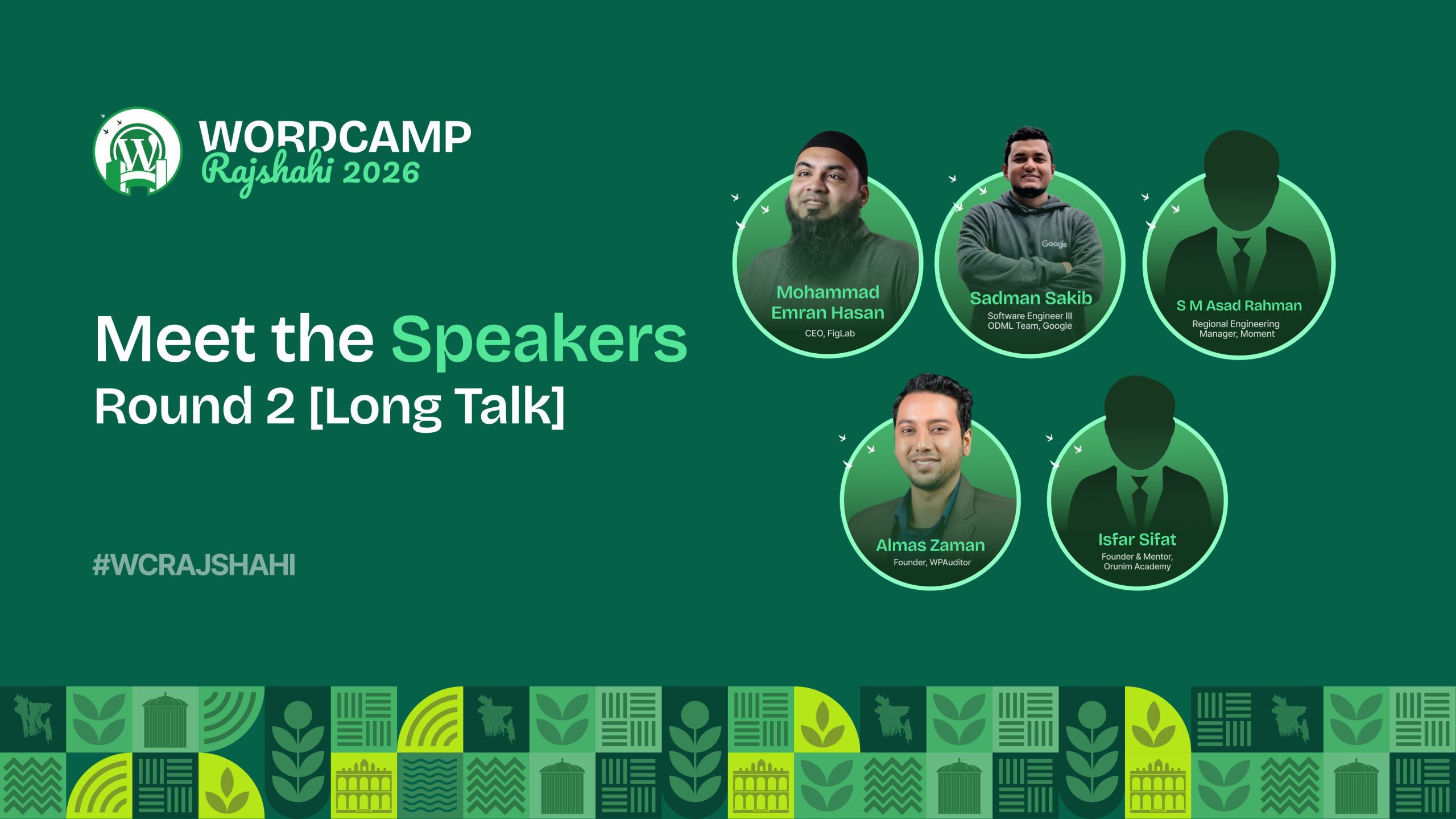
These are five people who have actually done the work they are about to talk about. Not theory, not borrowed frameworks, lived experience from inside the WordPress ecosystem. Here is who you will meet on 3rd July.
1. Sadman Sakib, Software Engineer III, Google

Session: Career Progression in the AI Era: Unlocking the Power of Agentic Workflows
Sadman is a software engineer and AI researcher from Bangladesh who has spent his career at the intersection of machine learning, distributed systems, and large-scale software engineering. He currently works at Google, contributing to AI-powered products and on-device machine learning technologies, building intelligent features that run across millions of devices. Before Google, he held engineering roles across Bangladesh, Taiwan, and the United States, working on machine learning, cloud infrastructure, and software systems. He is a graduate of the University of Dhaka with published academic research in interpretable deep learning, presented at leading AI research venues.
His session takes on a question most people are asking quietly: what does career growth actually look like when agentic AI is changing what engineers do every day? Sadman is not going to theorize about the future. He is going to walk through what agentic workflows look like in practice, how they shift the way engineers spend their time, and what that means for how you build a career that holds up through it.
2. Almas Zaman, Founder, WPAuditor

Session: From Finding Vulnerabilities to Securing WordPress
Almas is an information security researcher and cybersecurity professional with more than 12 years of hands-on industry experience. His expertise covers penetration testing, application security, source code auditing, digital forensics, reverse engineering, and exploit development. He is the founder of WPAuditor, a WordPress security monitoring solution built for threat detection, event logging, file integrity monitoring, and proactive defense. He currently serves as an Assistant Professor in the Department of CSE at Daffodil International University, and has held security leadership roles at Ollyo, The KOW Company, and government agencies.
WordPress security gets talked about in terms of plugins and checklists. Almas comes at it from a different angle: he finds the vulnerabilities first. This session traces the path from how attackers identify and exploit weaknesses in WordPress sites, to what a proper defense actually looks like once you understand how the attack works. If you manage WordPress sites in any capacity, as a developer, agency, or product team, this is the talk that gives you a more honest picture of what you are defending against.
3. Mohammad Emran Hasan, CEO, FigLab

Session: Building Better Software in the Age of AI
Emran is a technology entrepreneur, software architect, and product leader from Bangladesh with more than 25 years of experience designing, building, and scaling software products. He is the Founder and CEO of Klasio, an all-in-one SaaS platform for educators, trainers, and digital creators. Over his career he has held CTO, Software Architect, Technical Lead, and Engineering Manager roles, with expertise spanning PHP, Laravel, Symfony, cloud-native applications, SaaS development, and distributed systems. He is a known voice in the developer community on engineering leadership and sustainable product growth.
AI has made it easier to write code. It has not made it easier to build software that lasts. Emran’s session is about the difference: how to use AI as a genuine accelerator without letting it turn your codebase into a pile of fast-generated technical debt. After 25 years of watching what makes software hold up and what quietly collapses, he has a precise view on where AI helps, where it misleads, and what good engineering judgment still looks like in 2026.
4. Isfar Sifat, Founder and Mentor, Orunim Academy

Session: Why You Shouldn’t Stop What You’re Doing, How Small, Consistent Steps Took Me from RUET to the Global WordPress Community
Isfar is a software crafter with nearly 15 years of experience building and scaling systems for Silicon Valley startups, Y Combinator-backed companies, and technology organizations across the US and Europe. He has worked on large-scale platforms serving hundreds of millions of users, across e-commerce, fintech, customer experience, and transport optimization. His technical interests run deep: search engines, database internals, distributed systems, performance engineering, and scalable architecture. Beyond building, he is invested in engineering excellence, technical leadership, and mentoring the next generation of developers.
Most Node.js developers can repeat the words. Very few can explain what is actually happening underneath them, and even fewer can tell you why it matters for the code they write every day. Isfar’s session strips the jargon back to the actual model: how the event loop works, what non-blocking really means at the execution level, and how understanding this changes how you design and debug Node.js applications. If you have ever pasted that phrase into a README without being fully sure you could defend it, this session is for you.
5. S M Asad Rahman, Regional Engineering Manager, Moment

Session: Life Beyond %keyword%: Vector Databases and RAG from the Ground Up
Asad is a backend architect, engineering leader, and Agile practitioner with nearly two decades of experience designing scalable distributed systems, cloud-native platforms, and high-performance backend infrastructure. He currently serves as Backend Architect and Engineering Lead at Momentco.ai, architecting a modern microservices platform for next-generation sports fan engagement on Google Cloud Platform. Previously he was CTO at Monstarlab Bangladesh, where he led an engineering organization that scaled to more than 100 engineers and delivered over 200 projects across AI, SaaS, e-commerce, and enterprise software. He holds a PMI Agile Certified Practitioner credential and is a regular speaker and writer on software architecture, cloud-native engineering, and AI agent systems.
RAG gets discussed a lot. It gets implemented badly even more often. Asad’s session goes back to first principles: what a vector database actually is, how retrieval-augmented generation works at the system level, and how to build it in a way that works reliably rather than just impressively in a demo. If you have read the tutorials and still feel like you are missing something structural, this is where that gap gets closed.
Round 2 is done. There is still more.
Five speakers across AI career strategy, WordPress security, software architecture, Node.js internals, and production-ready RAG systems. These are not surface-level sessions, they are the kind of talks that change how you approach your work the week after you hear them.
More announcements are coming. Stay tuned and we will see you in Rajshahi.
Conference Day: 3rd July 2026 | 📍 RUET Auditorium, Rajshahi